|
|
|
|
Research
Interests :
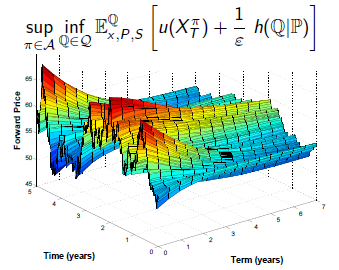 |
My current interests span Mathematical Finance, Financial
Engineering and Actuarial Science. In particular, I have been
working on topics including:
- High frequency algorithmic trading
- Applied stochastic control in Finance
- Mean-Field Games with Financial Applications
- Machine learning in finance
- Commodity Modeling and Derivative Valuation
- Homogenization and Singular Perturbation in Finance and
Insurance
- Real Options
- Valuation of financial linked insurance products
You can find links to my published and working papers
below. |
Colleagues and Students :
The Mathematical Finance/Actuarial Science research group in the
Department of Statistics consists of four professors :
Prof. A.
Badescu, Prof. S. Broverman,
Prof. S.
Jaimungal, and Prof. X. S. Lin
and several Ph.D. students.
Here is a list of my current students and their research
interests:
| Student |
Research Topic |
| Zhen Qin |
Commodity Models and Ambiguity Aversion |
| David Farahany |
Monte Carlo-PDE nethods for Option Valuation |
| Tianyi Jia |
FX markets and trading |
| Luhui (Luke) Gan |
Algorithmic Trading |
| Xuancheng (Bill) Huang |
Mean Field Games |
| Ali Al-Aradi |
Stochastic Portfolio Theory |
| Philippe Casgrain |
Partial Information in Algorithmic Trading |
Here is a list of our current Post Docs and their research
interests:
| Post Docs |
Research Topic |
| Omid Namvar Gharehshiran |
Reinforcement learning in algorithmic trading |
Here are my former Ph.D. Student's theses:
|
|
|
The FST Methods
The FST, mrFST and irFST method, developed in collaboration with K. Jackson
and V. Surkov, for valuing a variety of options allows for efficient
computation of path-dependent options for equities, commodities, and interest
rate derivatives. The underlying dynamics is based on Levy models with and
without regime changes and with and without mean-reversion. You can find the
relevant research papers below. Matlab source code can also be found here: http://fst-framework.sourceforge.net/
Publications and Working Papers
[Below you will find my working papers and publications.]
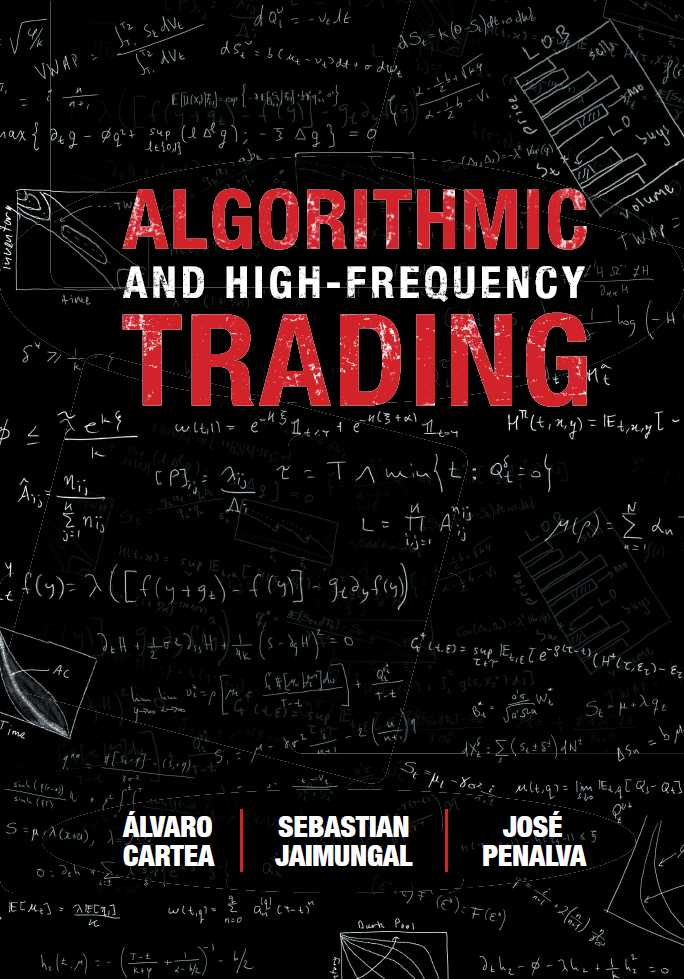
Algorithmic
and High Frequency Trading, with Álvaro Cartea and Jose Penalva,
Cambridge University Press, now available!
Order here from CUP
Order here from Amazon.co.uk
Order here from Amazon.com
Click here for the book
website where you can find data, code and other materials related
to the book.
Portfolio Liquidation and Ambiguity Aversion [ PDF] with Álvaro Cartea and Ryan Donnelly
We consider an optimal execution problem where an agent holds a position in an asset which must be liquidated (using limit orders) before a terminal horizon. Beginning with a standard model for the trading dynamics, we analyse how the acknowledgement of model misspecification affects the agent's optimal trading strategy. The three possible sources of misspecification in this context are: (i) the arrival rate of market orders, (ii) the fill probability of limit orders, and (iii) the dynamics of the asset price. We show that ambiguity aversion with respect to each factor of the model has a similar effect on the optimal strategy, but the magnitude of the effect depends on time and inventory position in different ways depending on the source of uncertainty. In addition we allow the agent to employ market orders to further increase the strategy's profitability and show the effect of ambiguity aversion on the shape of the optimal impulse region. In some cases we have a closed-form expression for the optimal trading strategy which significantly enhances the efficiency in which the strategy can be executed in real time.
Hedge and Speculate: replicating option payoffs with limit and market orders [ PDF] with Álvaro Cartea and Luhui Gan
We consider an agent who takes a short position in a contingent claim and employs limit orders (LOs) and market orders (MOs) to trade in the underlying asset to maximize expected utility of terminal wealth. The agent solves a combined optimal stopping and control problem where trading has frictions: MOs (executed by the agent and other traders) have permanent price impact and pay exchange fees, and LOs earn the spread (relative to the midprice of the asset) and pay no exchange fees. We show how the agent replicates the payoff of the claim and also speculates in the asset to maximize expected utility of terminal wealth. In the strategy, MOs are used to keep the inventory on target, to replicate the payoff, and LOs are employed to build the inventory at favorable prices and boost expected terminal wealth by executing roundtrip trades that earn the spread. We calibrate the model to the E-mini contract that tracks the S\&P500 index, provide numerical examples of the performance of the strategy, and proof that our scheme converges to the viscosity solution of the dynamic programming equation.
Beating the Market: Dynamic Asset Allocation with a Market Portfolio Benchmark [ PDF] with Ali Al-Aradi
Beating the market portfolio is a problem faced by many investors. Here, we formulate and solve a dynamic allocation problem that maximizes the
utility of relative wealth of the investor's portfolio to that of the market portfolio. We also allow the investor to control the deviation of the optimal
allocation from the market portfolio itself, and using stochastic control techniques, provide explicit closed form expressions for the optimal allocation.
In addition, we demonstrate how the optimal portfolio can be factored into five passive rule-based portfolios: (i) global minimum variance portfolio;
(ii) high-growth portfolio; (iii) high-cash-flow portfolio; (iv) equal-weight portfolio; and (v) risk-parity portfolio. Finally, some numerical experiments
based on calibration to real-world data are presented to illustrate the risk-reward profile of the optimal allocation in comparison to these and other commonly used strategies.
Trading algorithms with learning in latent alpha models [ PDF ] with Philippe Casgrain
Alpha signals for statistical arbitrage strategies are often driven by latent factors. This paper analyses how to optimally trade with latent factors that cause prices to jump and diffuse. Moreover, we account for the effect of the trader's actions on quoted prices and the prices they receive from trading. Under fairly general assumptions, we demonstrate how the trader can learn the posterior distribution over the latent states, and explicitly solve the latent optimal trading problem. To illustrate the efficacy of the optimal strategy, we demonstrate its performance through simulations and compare it to strategies which ignore learning in the latent factors.
Mixing LSMC and PDE Methods to Price Bermudan Options [ PDF with David Farahany and Ken Jackson
We develop a mixed least square Monte Carlo-partial differential equation (LSMC-PDE) method for pricing Bermudan style options with assets whose dynamics are driven by latent variables. The algorithm is formulated for an arbitrary number of assets and volatility processes, and its probabilistic convergence is established. Our numerical examples focus on the Heston model and we compare our hybrid algorithm with a full LSMC approach. Using Fourier methods we are able to derive efficient FFT based solutions, and we demonstrate that our algorithm greatly reduces the variance in the computed prices and optimal exercise boundaries. We also compare the early exercise boundaries and prices computed by our hybrid algorithm with those produced by �finite difference methods and �find excellent agreement.
Speculative Trading of Electricity Contracts in Interconnected Locations [ PDF ] with Álvaro Cartea and Zhen Qin
We derive an investor's optimal trading strategy of electricity contracts traded in two locations joined by an interconnector. The investor employs a price model which includes the impact of her own trades. The investor's trades have a permanent impact on prices because her trading activity affects the demand of contracts in both locations. Additionally, the investor receives prices which are worse than the quoted prices as a result of the elasticity of liquidity provision of contracts. Furthermore, the investor is ambiguity averse, so she acknowledges that her model of prices may be misspecified and considers other models when devising her trading strategy. We show that as the investor's degree of ambiguity aversion increases, her trading activity decreases in both locations, and thus her inventory exposure also decreases. Finally, we show that there is a range of ambiguity aversion parameters where the Sharpe ratio of the trading strategy increases when ambiguity aversion increases.
Liquidating Baskets of Co-Moving Assets[
PDF ] with Álvaro Cartea and Luhui
Gan
We show how to execute a basket consisting of a subset of
co-moving assets and demonstrate how the information carried in other traded
assets, which are not in the basket, improves execution performance. Market
orders (MOs) from all participants, including the agent's orders to execute her
basket, have permanent price impact on the assets, i.e. executions in a single
asset affect prices of all assets. Furthermore, we assume the agent's MOs are
executed at worse than midprices (by walking the LOB) through a temporary price
impact. The execution problem is posed as an optimal stochastic control one and
we reduce the dynamic programming equation to a system of coupled partial
differential equations, which reduces to a coupled system of Riccati equations
when other agents' order flow are deterministic. We use data of five stocks
traded in the Nasdaq exchange to estimate the model parameters and use
simulations to illustrate the performance of the strategy. As an example, the
agent liquidates a portfolio consisting of shares in INTC and SMH. We show that
including the information provided by three additional assets (FARO, NTAP,
ORCL) considerably improves the strategy's performance -- for the portfolio we
execute, it outperforms the multi-asset version of Almgren-Chriss by
approximately 2 to 4 basis points per share.
Enhancing Trading Strategies using Order Book Signals [ PDF ] with Álvaro Cartea and Ryan
Donnelly
We use high-frequency data from the Nasdaq exchange to build
a measure of volume order imbalance in the limit order book (LOB). We show that
our measure is a good predictor of the sign of the next market order (MO), i.e.
buy or sell, and also helps to predict price changes immediately after the
arrival of an MO. Based on these empirical findings, we introduce and calibrate
a Markov chain modulated pure jump model of price, spread, LO and MO arrivals,
and order imbalance. As an application of the model, we pose and solve a
stochastic control problem for an agent who maximizes terminal wealth, subject
to inventory penalties, by executing roundtrip trades using LOs. We use
in-sample-data (January to June 2014) to calibrate the model to ten equities
traded in the Nasdaq exchange, and use out-of-sample data (July to December
2014) to test the performance of the strategy. We show that introducing our
volume imbalance measure into the optimisation problem considerably boosts the
profits of the strategy. Profits increase because employing our imbalance
measure reduces adverse selection costs and positions LOs in the book to take
advantage of favorable price movements.
Trading Strategies within the Edges of No-Arbitrage [ PDF ] with Álvaro Cartea and Jason
Ricci
We develop a trading strategy which employs limit and market
orders in a multi-asset economy where the assets are not only correlated, but
can also be structurally dependent. To model the structural dependence, the
midprice processes follow a multivariate reflected Brownian motion on the
closure of a no-arbitrage region which is dictated by the assets' bid-ask
spreads. We provide a formal framework for such an economy and solve for the
value function and optimal control for an investor who takes positions in these
assets. The optimal strategy exhibits two dominant features which depend on how
far the vector of midprices is from the no-arbitrage bounds. When midprices are
sufficiently far from the no-arbitrage edges, the strategy behaves as that of a
market maker who posts buy and sell limit orders. And when the midprice vector
is close to the edge of the no-arbitrage region, the strategy executes a
combination of market orders and limit orders to profit from statistical
arbitrages. Moreover, we discuss a numerical scheme to solve for the value
function and optimal control, and perform a simulation study to discuss the
main characteristics of the optimal strategy.
Algorithmic Trading of Co-Integrated Assets [ PDF ] with Álvaro Cartea,
Int. J. Theoretical and Applied Finance, Forthcoming
We assume that the drift in the returns of asset prices
consists of an idiosyncratic component and a common component given by a
co-integration factor. We analyze the optimal investment strategy for an agent
who maximizes expected utility of wealth by dynamically trading in these
assets. The optimal solution is constructed explicitly in closed-form and is
shown to be affine in the co-integration factor. We calibrate the model to
three assets traded on the Nasdaq exchange (Google, Facebook, and Amazon) and
employ simulations to showcase the strategy's performance.
Foreign Exchange Markets with Last Look [ PDF ] with Álvaro Cartea
We examine the Foreign Exchange (FX) spot price spreads with
and without Last Look on the transaction. We assume that brokers are
risk-neutral and they quote spreads so that losses to latency arbitrageurs
(LAs) are recovered from other traders in the FX market. These losses are
reduced if the broker can reject, ex-post, loss-making trades by enforcing the
Last Look option which is a feature of some trading venues in FX markets. For a
given rejection threshold the risk-neutral broker quotes a spread to the market
so that her expected profits are zero. When there is only one venue, we find
that the Last Look option reduces quoted spreads. However, if there are two
venues we show that the market reaches an equilibrium where traders have no
incentive to migrate. The equilibrium can be reached with both venues
coexisting, or with only one venue surviving. Moreover, when one venue enforces
Last Look and the other one does not, counterintuitively, it may be the case
that the Last Look venue quotes larger spreads.
Model Uncertainty in Commodity Markets [ PDF ] with Álvaro Cartea and Zhen
Qin, SIAM Journal of Financial Mathematics, Forthcoming
Agents who acknowledge that their models are incorrectly
specified are said to be ambiguity averse, and this affects the prices they are
willing to trade at. Models for prices of commodities attempt to capture three
stylized features: seasonal trend, moderate deviations (a diffusive factor) and
large deviations (a jump factor) both of which mean-revert to the seasonal
trend. Here we model ambiguity by allowing the agent to consider a class of
models absolutely continuous w.r.t. their reference model, but penalize
candidate models that are far from it. The buyer (seller) of a forward contract
introduces a negative (positive) drift in the dynamics of the spot price, and
enhances downward (upward) jumps so the prices they are willing to trade at are
lower (higher) than that of the forward price under P. When ambiguity averse
buyers and sellers employ the same reference measure they cannot trade because
the seller requires more than what the buyer is willing to pay. Finally, we
observe that when ambiguity averse agents price options written on the
commodity forward, the effect of ambiguity aversion is strongest when the
option is at-the-money, and weaker when it is deep in-the-money or deep
out-of-the-money.
Irreversible Investments and Ambiguity Aversion [ PDF ] with Álvaro Cartea
Real-option valuation traditionally is concerned with
investment under conditions of project-value uncertainty, while assuming that
the agent has perfect confidence in a specific model. However, agents generally
do not have perfect confidence in their models, and this ambiguity affects
their decisions. Moreover, real investments are not spanned by tradable assets
and generate inherently incomplete markets. In this work, we account for an
agent's aversion to model ambiguity and address market incompleteness through
the notation of robust indifference prices. We derive analytical results for
the perpetual option to invest and the linear complementarity problem that the
finite time problem satisfies. We find that ambiguity aversion has dual effects
that are similar to, but distinct from, those of risk aversion. In particular,
agents are found to exercise options earlier or later than their
ambiguity-neutral counterparts, depending on whether the ambiguity stems from
uncertainty in the investment or in a hedging asset.
Mean-Field Game Strategies for Optimal Execution [PDF ] with
Bill Huang and Mojtaba Nourian
Algorithmic trading strategies for execution often focus on the individual agent who is liquidating/acquiring shares. When generalized to multiple agents, the resulting stochastic game is notoriously difficult to solve in closed-form. Here, we circumvent the difficulties by investigating a mean-field game framework containing (i) a major agent who is liquidating a large number of shares, (ii) a number of minor agents (high-frequency traders (HFTs)) who detect and trade against the liquidator, and (iii) noise traders who buy and sell for exogenous reasons. Our setup accounts for permanent price impact stemming from all trader types inducing an interaction between major and minor agents. Both optimizing agents trade against noise traders as well as one another. This stochastic dynamic game contains couplings in the price and trade dynamics, and we use a mean-field game approach to solve the problem. We obtain a set of decentralized feedback trading strategies for the major and minor agents, and express the solution explicitly in terms of a deterministic fixed point problem. For a finite $N$ population of HFTs, the set of major-minor agent mean-field game strategies is shown to have an $\epsilon_N$-Nash equilibrium property where $\epsilon_N\to0$ as $N\to\infty$.
Incorporating Order-Flow into Optimal Execution [ PDF ] with Álvaro Cartea,
Mathematics and Financial Economics, Forthcoming
We provide an explicit closed-form strategy for an investor who executes a
large order when market order-flow from all agents, including the investor's
own trades, has a permanent price impact. The strategy is found in closed-form
when the permanent and temporary price impacts are linear in the market's and
investor's rates of trading. We do this under very general assumptions about
the stochastic process followed by the order-flow of the market. The optimal
strategy consists of an Almgren-Chriss execution strategy adjusted by a
weighted-average of the future expected net order-flow (given by the difference
of the market's rate of buy and sell market orders) over the execution trading
horizon and proportional to the ratio of permanent to temporary linear impacts.
We use historical data to calibrate the model to five Nasdaq traded stocks
(FARO, SMH, NTAP, ORCL, INTC) and use simulations to show how the strategy
performs.
Order-Flow and Liquidity Provision [ PDF ] with Álvaro Cartea
We show how to optimally take positions in the limit order book by placing
limit orders at-the-touch when the midprice of the asset is affected by the
trading activity of the market. The midprice dynamics have a short-term-alpha
component which reflects how instantaneous net order-flow, the difference
between the number of market buy and market sell orders, affects the asset's
drift. If net-order flow is positive (negative), so short-term-alpha is
positive (negative), the strategy may even withdraw from the sell (buy) side of
the limit order book to take advantage of inventory appreciation (depreciation)
and to protect the trading strategy from adverse selection costs.
A Closed-Form Execution Strategy to Target VWAP [ PDF ] with Álvaro Cartea, SIAM J. Financial Mathematics, Forthcoming
We provide two explicit closed-form optimal execution strategies to target
VWAP. We do this under very general assumptions about the stochastic process
followed by the volume traded in the market, and the agent's orders have both
temporary and permanent impact on the midprice. The strategies that target VWAP
are found in closed-form. One strategy consists of TWAP adjusted upward by a
fraction of instantaneous order-flow and adjusted downward by the average
order-flow that is expected over the remaining life of the strategy. The other
strategy consists of the Almgren-Chriss execution strategy adjusted by the
expected volume and net order-flow during the remaining life of the strategy.
We calibrate model parameters to five stocks traded in Nasdaq (FARO, SMH, NTAP,
ORCL, INTC) and use simulations to show that the strategies target VWAP very
closely and on average outperform the target by between 0.10 and 8 basis
points.
Optimal Execution with Limit and Market Orders [ PDF ] with Álvaro Cartea,
Quantitative Finance, Vol. 15, No. 8, 1279–1291
We develop an optimal execution policy for an investor seeking to execute a
large order using limit and market orders. The investor solves the optimal
policy considering different restrictions on volume of both types of orders and
depth at which limit orders are posted. As a particular example we show how the
execution policies perform when targeting the volume schedule of the
time-weighted-average-price (TWAP). The different strategies considered by the
investor always outperform TWAP with an average savings per share of about two
to three times the spread. This improvement over TWAP is due to the strategies
benefiting from the optimal mix of limit orders, which earn the spread, and
market orders, which keep the investor's inventory schedule on target.
How to Value a Gas Storage Facility [ PDF ] with Álvaro Cartea and James
Cheeseman, Chapter in
Handbook of Multi-Commodity Markets and Products: Structuring, Trading and Risk
Management, (The Wiley Finance Series)
We show how to value a storage facility using
Least Squares Monte Carlo (LSMC). We present a toy model to understand how to
employ the LSMC algorithm and then show how to incorporate realistic
constraints in the valuation including: the maximum capacity of the storage,
injection and withdrawal rates and costs, and market constraints such as
bid-ask spread in the spot market and transaction costs.
Algorithmic Trading with Learning [ PDF ] with Álvaro Cartea and Damir
Kinzebulatov, Int. J. Theoretical and Applied Finance, Forthcoming
We propose a model where an algorithmic trader
takes a view on the distribution of prices at a future date and then decides
how to trade in the direction of her predictions using the optimal mix of
market and limit orders. As time goes by, the trader learns from changes in
prices and updates her predictions to tweak her strategy. Compared to a trader
that cannot learn from market dynamics or form a view of the market, the
algorithmic trader's profits are higher and more certain. Even though the
trader executes a strategy based on a directional view, the sources of profits
are both from making the spread as well as capital appreciation of inventories.
Higher volatility of prices considerably impairs the trader's ability to learn
from price innovations, but this adverse effect can be circumvented by learning
from a collection of assets that co-move.
Optimal Accelerated Share Repurchases [ PDF ] with Damir Kinzebulatov and
Dmitri H. Rubisov
An accelerated share repurchase (ASR) allows a firm to
repurchase a significant portion of its shares immediately, while shifting the
burden of reducing the impact and uncertainty in the trade to an intermediary.
The intermediary must then purchase the shares from the market over several
days, weeks, or as much as several months. Some contracts allow the
intermediary to specify when the repurchase ends, at which point the
corporation and the intermediary exchange the difference between the arrival
price and the TWAP over the trading period plus a spread. Hence, the
intermediary effectively has an American option embedded within an optimal
execution problem. As a result, the firm receives a discounted spread relative
to the no early exercise case. In this work, we address the intermediary's
optimal execution and exit strategy taking into account the impact that trading
has on the market. We demonstrate that it is optimal to exercise when the TWAP
exceeds \zeta(t) S_t where S_t is the fundamental price of the asset and
\zeta(t) is deterministic. Moreover, we develop a dimensional reduction of the
stochastic control and stopping problem and implement an efficient numerical
scheme to compute the optimal trading and exit strategies.
Algorithmic Trading with Model Uncertainty [ PDF ] with Álvaro Cartea and Ryan
Donnelly, SIAM Financial Mathematics, Forthcoming
Because algorithmic traders acknowledge that their models are incorrectly
specified we allow for ambiguity in their choices to make their models robust
to misspecification. We show how to include misspecification to: (i) the
arrival rate of market orders (MOs), (ii) the fill probability of limit orders,
and (iii) the dynamics of the midprice of the asset they trade. In the context
of market making, we demonstrate that market makers (MMs) adjust their quotes
to reduce inventory risk and adverse selection costs. Moreover, robust market
making increases the strategy's Sharpe ratio and allows the MM to fine tune the
tradeoff between the mean and the standard deviation of profits. Our framework
adopts a robust optimal control approach and we provide existence and
uniqueness results for the robust optimal strategies as well as a verification
theorem. The behavior of the ambiguity averse MM generalizes that of a risk
averse MM, and coincide in only one circumstance.
A real options model to evaluate the effect of environmental
policies on the oil sands rate of expansion [ PDF ] with Laleh Kobari and Yuri
Lawryshyn, Energy Economics, Volume 45, September 2014, Pages
155-165
Canadian oil sands hold the third largest recognized oil
deposit in the world. While the rapidly expanding oil sands industry in western
Canada has driven economic growth, the extraction of the oil comes at a
significant environmental cost. It is believed that the government policies
have failed to keep up with the rapid oil sands expansion, creating serious
challenges in managing the environmental impacts. This paper presents a
practical, yet financially sound, real options model to evaluate the rate of
oil sands expansion, under different environmental cost scenarios resulting
from governmental policies, while accounting for oil price uncertainty and
managerial flexibilities. Our model considers a multi-plant/multi-agent
setting, in which labor costs increase for all agents and impact their optimal
strategies, as new plants come online. Our results show that a stricter
environmental cost scenario delays investment, but leads to a higher rate of
expansion once investment begins. Once constructed, a plant is highly unlikely
to shut down. Our model can be used by government policy makers, to gauge the
impact of policy strategies on the oil sands expansion rate, and by oil
companies, to evaluate expansion strategies based on assumptions regarding
market and taxation costs.
Optimal Execution with a Price Limiter [ PDF ] with Damir Kinzebulatov,
RISK, July 2014
Agents often wish to limit the price they pay for an asset.
If they are acquiring a large number of shares, they must balance the risk of
trading slowly (to limit price impact) with the risk of future uncertainty in
prices. Here, we address the optimal acquisition problem for an agent who is
unwilling to pay more than a specified price for an asset while they are
subject to market impact and price uncertainty. The problem is posed as an
optimal stochastic control and we provide an analytical closed form solution
for the perpetual case as well as a dimensional reduced PDE for the general
case. The optimal seed of trading is found to no longer be deterministic and
instead depends on the fundamental price of the asset. Moreover, we demonstrate
that a price limiter constraint significantly reduces the conditional tail
expectation of the securities costs.
Risk Metrics and Fine Tuning of High Frequency Trading
Strategies[ PDF ] with
Álvaro Cartea, Mathematical Finance, Vol. 25(3), 576-611
We propose risk measures to assess the performance of High Frequency (HF)
trading strategies that seek to maximize profits from making the realized
spread where the holding period is extremely short (fractions of a second,
seconds or at most minutes). The HF trader is risk-neutral and maximizes
expected terminal wealth but is constrained by both capital and the amount of
inventory that she can hold at any time. The risk measures enable the HF trader
to fine tune her strategies by trading off different measures of inventory
risk, which also proxy for capital risk, against expected profits. The dynamics
of the midprice of the asset are driven by information flows which are
impounded in the midprice by market participants who update their quotes in the
limit order book. Furthermore, the midprice also exhibits stochastic jumps as a
consequence of the arrival of market orders that have an impact on prices which
can give rise to market momentum (expected prices to trend up or down).
Valuing GWBs with Stochastic Interest Rates and Volatility
[ PDF ] with Dmitri Rubisov and
Ryan Donnelly, Quantitative Finance, 14(2) pg. 369-382
Guaranteed withdrawal benefits (GWBs) are long term
contracts which provide investors with equity participation while guaranteeing
them a secured income stream. Due to the long investment horizons involved,
stochastic volatility and stochastic interest rates are important factors to
include in their valuation. Moreover, investors are typically allowed to
participate in a mixed fund composed of both equity and fixed-income
securities. Here, we develop an efficient method for valuing these
path-dependent products through re-writing the problem in the form of an Asian
styled claim and a dimensionally reduced PDE. The PDE is then solved using an
Alternating Direction Implicit (ADI) method. Furthermore, we derive an
analytical closed form approximation and compare this approximation with the
PDE results and find excellent agreement. We illustrate the various effects of
the parameters on the valuation through numerical experiments and discuss their
financial implications.
Buy Low Sell High: A High Frequency Trading Perspective [
PDF ] with Álvaro Cartea and
Jason Ricci, SIAM Journal of Financial Mathematics, 5.1 (2014):
415-444.
We develop a High Frequency (HF) trading strategy where the
HF trader uses her superior speed to process information and to post limit sell
and buy orders. We introduce a multi-factor self-exciting process which allows
for feedback effects in market buy and sell orders and the shape of the limit
order book (LOB). The model accounts for arrival of market orders that
influence activity, trigger one-sided and two-sided clustering of trades, and
induce temporary changes in the shape of the LOB. The resulting strategy
outperforms the Poisson strategy where the trader does not distinguish between
influential and non-influential events.
The Generalized Shiryaev's Problem and Skorohod Embedding [
PDF ] with Alex Kreinin and Angel
Valov,Theory Probab. Appl., 58(3), 493–502
In this paper we consider a connection between the famous
Skorohod embedding problem and the Shiryaev inverse problem for the first
hitting time distribution of a Brownian motion: given a probability
distribution, F, find a boundary such that the first hitting time distribution
is F. By randomizing the initial state of the process we show that the inverse
problem becomes analytically tractable. The randomization of the initial state
allows us to significantly extend the class of target distributions in the case
of a linear boundary and moreover allows us to establish connection with the
Skorohod embedding problem.
Valuing Clustering in Catastrophe Derivatives [ PDF ] with Yuxiang Chong,
Quantitive Finance, 14(2) pg. 259-270
The role that clustering in activity and/or severity plays
in catastrophe modeling and derivative valuation is a key aspect that has been
overlooked in the recent literature. Here, we propose two marked point
processes to account for these features. The first approach assumes the points
are driven by a stochastic hazard rate modulated by a Markov chain while marks
are drawn from a regime specific distribution. In the second approach, the
points are driven by a self-exciting process while marks are drawn from a fixed
distribution. Within this context, we provide a unified approach to efficiently
value catastrophe options -- such as those embedded in catastrophe bonds -- and
show that our results are within the 95% confidence interval computed using
Monte Carlo simulations. Our approach is based on deriving the valuation PIDE
and utilizes transforms to provide semi-analytical closed form solutions. This
contrasts with most prior works where the valuation formulae require computing
several infinite sums together with numerical integration.
Incorporating Managerial Information into Real Option
Valuation [ PDF ] with
Yuri Lawryshyn, Commodities, Energy and Environmental Finance, vol.
74,chap. Incorporating Managerial Information into Real Option
Valuation, pp. 213–238.Springer (2015)
Real options analysis (ROA) is widely recognized as a
superior method for valuing projects with managerial flexibilities. Yet, its
adoption remains limited due to varied difficulties in its implementation. In
this work, we propose a real options approach that utilizes managerial
cash-flow estimates to value early stage project investments. By introducing a
sector indicator process which drives the project-value we are able to match
arbitrary managerial cash-flow distributions. This sector indicator allows us
to value managerial flexibilities and obtain hedges in an easy to implement
manner. Our approach to ROA is consistent with financial theory, requires
minimal subjective input of model parameters, and bridges the gap between
theoretical ROA frameworks and practice.
Modeling Asset Prices for Algorithmic and High Frequency
Trading [ PDF ] with
Álvaro Cartea, Applied Mathematical Finance, 20 (6) pg. 512-547
Algorithmic Trading (AT) and High Frequency (HF) trading,
which are responsible for over 70% of US stocks trading volume, have greatly
changed the microstructure dynamics of tick-by-tick stock data. In this paper
we employ a hidden Markov model to examine how the intra-day dynamics of the
stock market have changed, and how to use this information to develop trading
strategies at ultra-high frequencies. In particular, we show how to employ our
model to submit limit-orders to profit from the bid-ask spread and we also
provide evidence of how HF traders may profit from liquidity incentives
(liquidity rebates). We use data from February 2001 and February 2008 to show
that while in 2001 the intra-day states with shortest average durations were
also the ones with very few trades, in February 2008 the vast majority of
trades took place in the states with shortest average durations. Moreover, in
2008 the fastest states have the smallest price impact as measured by the
volatility of price innovations.
Real Option Valuation with Uncertain Costs [ PDF ]
with Max O. de Souza and Jorge P. Zubelli. Euro Journal of Finance, 19
(7-8) pg. 625-644
In this work we are concerned with valuing the option to
invest in a project when the project value and the investment cost are both
mean-reverting. Previous works on stochastic project and investment cost
concentrate on geometric Brownian motions (GBMs) for driving the factors.
However, when the project involved is linked to commodities, mean-reverting
assumptions are more meaningful. Here, we introduce a model and prove that the
optimal exercise strategy is not a function of the ratio of the project value
to the investment V/I -- contrary to the GBM case. We also demonstrate that the
limiting trigger curve as maturity approaches traces out a non-linear curve in
the (V,I) plan and derive its explicit form. Finally, we numerically
investigate the finite-horizon problem using the Fourier space time-stepping
algorithm of Jaimungal & Surkov (2009). Numerically, the optimal exercise
policies are found to be approximately linear in V/I; however, contrary to the
GBM case they are not described by a curve of the form V*/I* = c(t). The option
price behavior as well as the trigger curve behavior nicely generalize earlier
one-factor model results.
Spectral Decomposition of Option Prices in Fast Mean-Reverting
Stochastic Volatility Models [ PDF ] with Jean-Pierre Fouque and
Matthew Lorig. SIAM Journal of Financial Mathematics (2) pp. 665-691
(2015)
Using spectral decomposition techniques and singular
perturbation theory, we develop a systematic method to approximate the prices
of a variety of options in a fast mean-reverting stochastic volatility setting.
Four examples are provided in order to demonstrate the versatility of our
method. These include: European options, up-and-out options, double-barrier
knock-out options, and options which pay a rebate upon hitting a boundary. For
European options, our method is shown to produce option price approximations
which are equivalent to those developed in Fouque, Papanicolaou, and Sircar
(2000).
Valuing Early Exercise Interest Rate Options with Multi-Factor
Affine Models [ PDF ][ Matlab ] with Vladimir Surkov.
Int. J. Theor. Appl. Finan. 16, 1350034 (2013)
Multi-factor interest rate models are widely used in
practice. Quite often, contingent claims with earlier exercise features are
valued by resorting to trees, finite-difference schemes and Monte Carlo
simulations. However, when jumps are present these methods are less accurate
and/or efficient. In this work we develop an algorithm based on a sequence of
measure changes coupled with Fourier transform solutions of the pricing
partial-integro differential equation to solve the pricing problem. The method,
coined the irFST method, also neatly computes option sensitivities.
Furthermore, we develop closed form formulae for accrual swaps and accrual
range notes under our multi-factor jump-diffusion model. We demonstrate the
versatility and precision of the method through numerical experiments on
European, Bermudan and callable bond options, (accrual) swaps and range
notes.
Randomized First Passage Times [ PDF ] with Alex Kreinin and Angelo
Valov.
In this article we study a problem related to the first
passage and inverse first passage time problems for Brownian motions originally
formulated by Jackson, Kreinin and Zhang (2009). Specifically, define $\tau_X =
\inf\{t>0:W_t + X \le b(t) \}$ where $W_t$ is a standard Brownian motion,
then given a boundary function $b:[0,\infty) \to \RR$ and a target measure
$\mu$ on $[0,\infty)$, we seek the random variable $X$ such that the law of
$\tau_X$ is given by $\mu$. We characterize the solutions, prove uniqueness and
existence and provide several key examples associated with the linear boundary.
Kernel-Based Copula Processes [ PDF ]
with Eddie K.H. Ng, ECML-PKDD 2009, LNAI 5781, pp. 628-643, 2009.
Kernel-based Copula Processes (KCPs), a new versatile tool
for analyzing multiple time-series, are proposed here as a unifying framework
to model the interdependency across multiple time-series and the long-range
dependency within an individual time-series. KCPs build on the celebrated
theory of copula which allows for the modeling of complex interdependence
structure, while leveraging the power of kernel methods for efficient learning
and parsimonious model specification. Specifically, KCPs can be viewed as a
generalization of the Gaussian processes enabling non-Gaussian predictions to
be made. Such non Gaussian features are extremely important in a variety of
application areas. As one application, we consider temperature series from
weather stations across the US. Not only are KCPs found to have modeled the
heteroskedasticity of the individual temperature changes well, the KCPs also
successfully discovered the interdependencies among different stations. Such
results are beneficial for weather derivatives trading and risk management, for
example.
Incorporating Risk Aversion and Model
Misspecification into a Hybrid Model of Default [ PDF ]
with G. Sigloch. Mathematical Finance, Vol. 22 (1), pp. 57-81, 2012
It is well known that purely structural models of default
cannot explain short term credit spreads, while purely intensity based models
of default lead to completely unpredictable default events. Here we introduce a
hybrid model of default in which a firm enters distress upon a non-tradable
credit worthiness index (CWI) hitting a critical level. Upon distress, the firm
defaults at the next arrival of a Poisson process. To value defaultable bonds
and CDSs we introduce the concept of robust indifference pricing which differs
from the usual indifference valuation paradigm by the inclusion of model
uncertainty. To account for model uncertainty, the embedded optimization
problems are modified to include a minimization over a set of candidate
measures equivalent to the estimated reference measure. With this new model and
pricing paradigm, we succeed in determining corporate bond spreads and CDS
spreads and find that model uncertainty plays a similar, but distinct, role to
risk aversion. In particular, model uncertainty allows for significant short
term spreads.
Integral Equations and the First Passage Time of
Brownian Motions [ PDF ]
with A. Kreinin and A. Valov.
The first passage time problem for Brownian motions hitting
a barrier has been extensively studied in the literature. In particular, many
incarnations of integral equations which link the density of the hitting time
to the equation for the barrier itself have appeared. Most interestingly,
Peskir(2002b) demonstrates that a master integral equation can be used to
generate a countable number of new equations via differentiation or integration
by parts. In this article, we generalize Peskir's results and provide a more
powerful unifying framework for generating integral equations through a new
class of martingales. We obtain a continuum of Volterra type integral equations
of the first kind and prove uniqueness for a subclass. Furthermore, through the
integral equations, we demonstrate how certain functional transforms of the
boundary affect the density function. Finally, we demonstrate a fundamental
connection between the Volterra integral equations and a class of Fredholm
integral equations.
An Insurance Risk Model with Stochastic
Volatility [ PDF ]
with Yichun Chi and Sheldon X. Lin. Insurance: Mathematics and
Economics.46(1), pg. 52-66.
In this paper, we extend the Cramer-Lundberg insurance risk
model perturbed by diffusion to incorporate stochastic volatility and study the
resulting Gerber-Shiu expected discounted penalty(EDP) function. Under the
assumption that volatility is driven by an underlying Ornstein-Uhlenbeck (OU)
process, we derive the integro-differential equation which the EDP function
satisfies. Not surprisingly, no closed-form solution exists; however, assuming
the driving OU process is fast mean-reverting, we apply singular perturbation
theory to obtain an asymptotic expansion of the solution. Two
integro-differential equations for the first two terms in this expansion are
obtained and explicitly solved. When the claim size distribution is of
phase-type, the asymptotic results simplify even further and we succeed in
estimating the error of the approximation. Hyper-exponential and mixed-Erlang
distributed claims are considered in some detail.
Levy Based Cross-Commodity Models and Derivative
Valuation [ PDF ][ Matlab ] with Vladimir Surkov.
SIAM Journal on Financial Mathematics (2) pp.464-487
Energy commodities, such as oil, gas and electricity, lack
the liquidity of equity markets, have large costs associated with storage,
exhibit high volatilities and can have significant spikes in prices.
Furthermore, and possibly most importantly, commodities tend to revert to long
run equilibrium prices. Many complex commodity contingent claims exist in the
markets, such as swing and interruptible options; however, the current method
of valuation relies heavily on Monte Carlo simulations and tree based methods.
In this article, we develop a new framework for dealing with mean-reverting
jump-diffusion (and pure jump) models by working in Fourier space. The method
is based on the Fourier space time stepping algorithm of Jackson, Jaimungal,
and Surkov (2008), but is tailored for mean-reverting models. We demonstrate
the utility of the method by applying it to the valuation of European, American
and barrier options on a single underlier, European and Bermudan spread options
on two-dimensional underliers, and swing options.
Stepping Through Fourier Space [ PDF ][ Matlab ] with Vladimir Surkov.
Risk, July, 2009, p78-83.
Diverse finite-difference schemes for solving pricing
problems with Levy underliers have been used in the literature. Invariably, the
integral and diffusive terms are treated asymmetrically, large jumps are
truncated, the methods are difficult to extend to higher dimensions and cannot
easily incorporate regime switching or stochastic volatility. We present a new
efficient approach which switches between Fourier and real space as time
propagates backwards. We dub this method Fourier Space Time-Stepping (FST). The
FST method applies to regime switching Levy models and is applicable to a wide
class of path-dependent options (such as Bermudan, barrier, shout and
catastrophe linked options) and options on multiple assets.
Fourier Space Time Stepping for Option Pricing with
Levy Models [ PDF ][
Matlab ] with Kenneth R.
Jackson and Vladimir Surkov. Journal of Computational Finance, Vol 12
Issue 2, p1-29.
Jump-diffusion and Levy models have been widely used to
partially alleviate some of the biases inherent in the classical
Black-Scholes-Merton model. Unfortunately, the resulting pricing problem
requires solving a more difficult partial-integro differential equation (PIDE)
and although several approaches for solving the PIDE have been suggested in the
literature, none are entirely satisfactory. All treat the integral and
diffusive terms asymmetrically, truncate large jumps and are difficult to
extend to higher dimensions. We present a new, efficient algorithm, based on
transform methods, which symmetrically treats the diffusive and integrals
terms, is applicable to a wide class of path-dependent options (such as
Bermudan, barrier, and shout options) and options on multiple assets, and
naturally extends to regime-switching Levy models. We present a concise study
of the precision and convergence properties of our algorithm for several
classes of options and Levy models and demonstrate that the algorithm is
second-order in space and first-order in time for path-dependent options.
Asymptotic Pricing of Commodity Derivatives for
Stochastic Volatility Spot Models [ PDF
] with Samuel Hikspoors. Applied Mathematical Finance, vol 15 Issue
5&6, p449-447.
It is well known that stochastic volatility is an essential
feature of commodity spot prices. By using methods of singular perturbation
theory, we obtain approximate but explicit closed form pricing equations for
forward contracts and options on single- and two-name forward prices. The
expansion methodology is based on a fast mean-reverting stochastic volatility
driving factor, and leads to pricing results in terms of constant volatility
prices, their Delta's and their Delta-Gamma's. The stochastic volatility
corrections lead to efficient calibration and sensitivity calculations.
Consistent Functional PCA for Financial
Time-Series [ PDF ]
with Eddie. K. H. Ng, Proceedings of the 4th IASTED International
Conference on Financial Engineering and Applications.
Functional Principal Component Analysis (FPCA) provides a
powerful and natural way to model functional financial data sets (such as
collections of time-indexed futures and interest rate yield curves). However,
FPCA assumes each sample curve is drawn from an independent and identical
distribution. This assumption is axiomatically inconsistent with financial
data; rather, samples are often interlinked by an underlying temporal dynamical
process. We present a new modeling approach using Vector auto-regression (VAR)
to drive the weights of the principal components. In this novel process, the
temporal dynamics are first learned and then the principal components
extracted. We dub this method the VAR-FPCA. We apply our method to the NYMEX
light sweet crude oil futures curves and demonstrate that it contains
significant advantages over the conventional FPCA in applications such as
statistical arbitrage and risk management.
Option Pricing with Regime Switching Levy processes
using Fourier Space Time Stepping [ PDF
] with Kenneth R. Jackson and Vladimir Surkov, Proceedings of the 4th
IASTED International Conference on Financial Engineering and Applications.
Although jump-diffusion and L´evy models have been widely
used in industry, the resulting pricing partial-integro differential equations
poses various difficulties for valuation. Diverse finite-difference schemes for
solving the problem have been introduced in the literature. Invariably, the
integral and diffusive terms are treated asymmetrically, large jumps are
truncated and the methods are difficult to extend to higher dimensions. We
present a new efficient transform approach for regime-switching L´evy models
which is applicable to a wide class of path-dependent options (such as
Bermudan, barrier, and shout options) and options on multiple assets.
Energy Spot Price Models and Spread Options
Pricing[ PDF
] with Samuel Hikspoors, International Journal of Theoretical and Applied
Finance, vol 10(7), pg. 1111-1135.
In this article, we construct forward price curves and value a class of two
asset exchange options for energy commodities. We model the spot prices using
an affine two-factor mean-reverting process with and without jumps. Within this
modeling framework, we obtain closed form results for the forward prices in
terms of elementary functions. Through measure changes induced by the forward
price process, we further obtain closed form pricing equations for spread
options on the forward prices. For completeness, we address both an Actuarial
and a risk-neutral approach to the valuation problem. Finally, we provide a
calibration procedure and calibrate our model to the NYMEX Light Sweet Crude
Oil spot and futures data, allowing us to extract the implied market prices of
risk for this commodity.
Catastrophe options with stochastic interest rates
and compound Poisson losses[ PDF
] with Tao Wang, Insurance Mathematics and Economics (2006) vol 38 (3)
469-483
We analyze the pricing and hedging of catastrophe put options under
stochastic interest rates with losses generated by a compound Poisson process.
Asset prices are modeled through a jump-diffusion process which is correlated
to the loss process. We obtain explicit closed form formulae for the price of
the option, and the hedging parameters Delta, Gamma and Rho. The effects of
stochastic interest rates and variance of the loss process on the options price
are illustrated through numerical experiments. Furthermore, we carry out a
simulation analysis to hedge a short position in the catastrophe put option by
using a DeltaGammaRho neutral self-financing portfolio. We find that accounting
for stochastic interest rates, through Rho hedging, can significantly reduce
the expected conditional loss of the hedged portfolio.
Pricing Equity Linked Pure Endowments with Risky
Assets that follow Levy Processes.[ PDF
] with Virginia Young, Insurance Mathematics and Economics (2005) vol 36
(3) 329-346
We investigate the pricing problem for pure endowment contracts whose life
contingent payment is linked to the performance of a tradable risky asset or
index. The heavy tailed nature of asset return distributions is incorporated
into the problem by modeling the price process of the risky asset as a finite
variation Levy process. We price the contract through the principle of
equivalent utility. Under the assumption of exponential utility, we determine
the optimal investment strategy and show that the indifference price solves a
non-linear partial-integro-differential equation (PIDE). We solve the PIDE in
the limit of zero risk aversion, and obtain the unique risk-neutral equivalent
martingale measure dictated by indifference pricing. In addition, through an
explicit–implicit finite difference discretization of the PIDE we numerically
explore the effects of the jump activity rate, jump sizes and jump skewness on
the pricing and the hedging of these contracts.
A Two-State Jump Model [ PDF ] with
Claudio Albanese and Dmitri .H. Rubisov, Quantitative Finance (2003) vol
3(2) 145-154
We introduce a pricing model for equity options in which sample paths follow
a variance-gamma (VG) jump model whose parameters evolve according to a
two-state Markov chain process. As in GARCH type models, jump sizes are
positively correlated to volatility. The model is capable of justifying the
observed implied volatility skews for options at all maturities. Furthermore,
the term structure of implied VG kurtosis is an increasing function of the time
to maturity, in agreement with empirical evidence. Explicit pricing formulae,
extending the known VG formulae, for European options are derived. In addition,
a resummation algorithm, based on the method of lines, which greatly reduces
the algorithmic complexity of the pricing formulae, is introduced. This
algorithm is also the basis of approximate numerical schemes for American and
Bermudan options, for which a state dependent exercise boundary can be
computed.
Jumping In Line [ PDF ]
with Claudio Albanese and Dmitri .H. Rubisov, RISK, Feb. issue, pg.
65-70
The variance gamma jump model is known to describe the volatility smile for
shortdatedoptions accurately. However, implementation for exotic path-dependent
optionscan prove difficult. Here, Claudio Albanese, Sebastian Jaimungal and
Dmitri Rubisov usethe method of lines to develop an alternative approach,
allowing prices to be calculatedin a more straightforward manner, either
analytically or through numerical integration